



Solar Leasing Opportunities In Maryland
Turn Your Unused Land into a Financial Asset
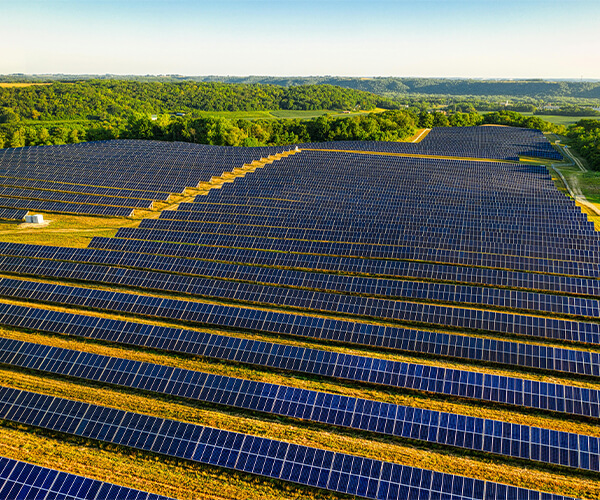
Maryland landowners with vacant or underproductive acreage could be putting that land to work. As the state pushes toward its mandate of 50% renewable electricity by 2030, Maryland solar development is accelerating, and developers are actively seeking qualifying sites. With over 3,100 MW of solar capacity already installed, record-breaking community solar growth, and newly streamlined permitting under the Renewable Energy Certainty Act, the opportunity for Maryland solar land leasing has never been more accessible.

How Solar Land Leases Deliver Consistent Income
A solar land lease is a long-term agreement, typically spanning 20 to 40 years, between a landowner and a solar developer. During that time, you receive predictable monthly or annual payments. Solar lease payments stay consistent regardless of market shifts or seasonal conditions, and most agreements include annual escalation clauses to keep pace with inflation.
Income Potential
Landowners earn stable, long-term passive income by leasing their land to solar developers. Payments are locked in at signing and typically increase annually over the life of the contract.
Environmental Impact
An acre of solar panels offsets roughly 175 to 198 metric tons of CO2 per year when displacing fossil fuel generation. For a typical community solar project spanning 30 to 50 acres, that adds up to thousands of tons of CO2 avoided annually, the equivalent of removing over a thousand cars from the road. Solar energy generation produces zero emissions during operation, contributing to improved air quality statewide.
Local Job Creation
Supporting Maryland solar development creates jobs across the state. Maryland’s solar industry already supports nearly 5,000 workers across 198 companies, and every new project adds construction, maintenance, and operations positions in local communities.
Why Lease Your Land for Solar in Maryland?
Financial Security and Stability
- Guaranteed long-term income: Solar leases typically offer predictable payments over 20 to 40 years, providing peace of mind and financial security.
- Supplement retirement planning: Transform your land into a dependable revenue stream to support your retirement goals.
Make Use of Underutilized Land
- Optimize land usage: Fields, pastures, or underperforming agricultural land can generate substantial income when leased for Maryland solar installations.
- Minimal maintenance: Solar farms require very little of your time or labor, leaving you free to focus on other endeavors.
Support Maryland’s Clean Energy Future
- Energy independence: Join the movement toward reducing reliance on fossil fuels. Maryland solar energy represents a clean, renewable solution for powering the state.
- Sustainability leadership: Contribute to Maryland’s goal of 50% renewable electricity by 2030, with a 14.5% solar carve-out, under the Clean Energy Jobs Act.
Is Your Land Eligible?
Solar developers are actively seeking:
- Flat or gently sloping land with access to sunlight.
- 10+ acres of underutilized or unused land.
- Proximity to utility infrastructure, such as substations or three-phase power lines.
Maryland & Solar Energy
Key Facts
- Maryland ranks 21st nationally in total installed solar capacity with over 3,100 MW.
- The state’s Renewable Portfolio Standard requires 50% renewable electricity by 2030, with a 14.5% solar carve-out.
- Maryland solar now generates enough electricity to power nearly 370,000 homes, representing 7.65% of the state’s electricity.
- Community solar installations in Maryland set a new record in 2025, totaling 76 MW with a 13% year-over-year increase.
- More than 114,500 solar installations are operating statewide, backed by $7.1 billion in total solar investment.
- Governor Wes Moore signed the Renewable Energy Certainty Act in 2025, streamlining and standardizing permitting for solar projects across the state.

What is Maryland’s Clean Energy Jobs Act?
The Clean Energy Jobs Act, passed by the Maryland General Assembly in 2019 with veto-proof margins, requires the state to source 50% of its electricity from renewable energy by 2030. The law includes a dedicated 14.5% carve-out for in-state solar energy and set a target of at least 1,200 MW of offshore wind capacity by 2030. The legislation also directed the state to evaluate a pathway toward 100% clean energy by 2040.
Key Features of the Clean Energy Jobs Act:
- Requires 50% renewable electricity by 2030, with a 14.5% in-state solar carve-out.
- Includes offshore wind targets of at least 1,200 MW by 2030.
- Directs the state to study pathways to 100% clean energy by 2040.
- Complemented by the 2025 Renewable Energy Certainty Act, which standardizes solar permitting statewide and removes barriers from inconsistent local zoning regulations.
The Solar Land Leasing Process In Maryland
Property Evaluation and Feasibility
The process begins with a comprehensive assessment of your property. U.S. Light Energy (USLE) examines your parcel’s solar potential, topography, proximity to utility infrastructure, and overall suitability to maximize both energy production and lease value.
Utility Infrastructure Analysis
USLE checks for nearby three-phase power lines, substation capacity, and interconnection availability. Properties closer to utility infrastructure tend to qualify for higher lease payments because they reduce development costs.
Environmental and Zoning Review
Environmental studies identify any wetlands, protected habitats, or sensitive areas on the property. USLE also reviews local zoning and land-use regulations. Maryland’s Renewable Energy Certainty Act has streamlined permitting for many solar projects, but a thorough review ensures compliance with all current requirements.
Lease Negotiation and Execution
Once feasibility is confirmed, USLE presents a lease agreement outlining payment terms, project parameters, and timelines. Option agreements typically allow developers to secure land rights while finalizing design and approvals.
Construction and Commissioning
USLE manages all construction activities, from site preparation and equipment installation to grid interconnection. Construction typically takes 6 to 12 months. Once the system is operational, landowners begin receiving full lease payments with annual increases throughout the operational period.
Frequently Asked Questions:
How much income can I expect from Maryland solar leasing?
Income depends on the size, location, and characteristics of your land. U.S. Light Energy conducts an in-depth feasibility analysis to assess each site’s potential and determine the most competitive lease terms for your property.
Will solar panels damage my land?
No. Solar panels are installed on mounting systems that preserve your land’s condition. Many landowners find that their soil quality has actually improved by the end of a lease term due to reduced erosion and natural vegetation recovery. At the end of the lease, the land can be restored to its original state.
Can I still use my land while leasing it for solar?
Yes. Some solar projects are compatible with dual-use practices, such as agrivoltaic farming, like grazing livestock under the panels or maintaining beekeeping operations alongside energy production.
Working With U.S. Light Energy In New York
U.S. Light Energy (USLE) is a distributed generation energy development company specializing in community solar facilities and renewable energy solutions. With over 30 years of solar PV, energy industry, and real estate development experience, USLE partners with Maryland landowners to create reliable income streams through community solar projects.
USLE’s feasibility process analyzes multiple aspects of every property to drive the most value per acre while positioning each project for success. Our team handles permitting, utility connections, and community relations so you can enjoy hassle-free income generation.
Ready To Lease Your Land For Solar In New York?
Leasing your land for solar in New York secures long-term income, supports your community, and puts you at the center of the state’s clean energy transition.
Contact Us or Request a Free Land Assessment to learn how much your land could earn.